
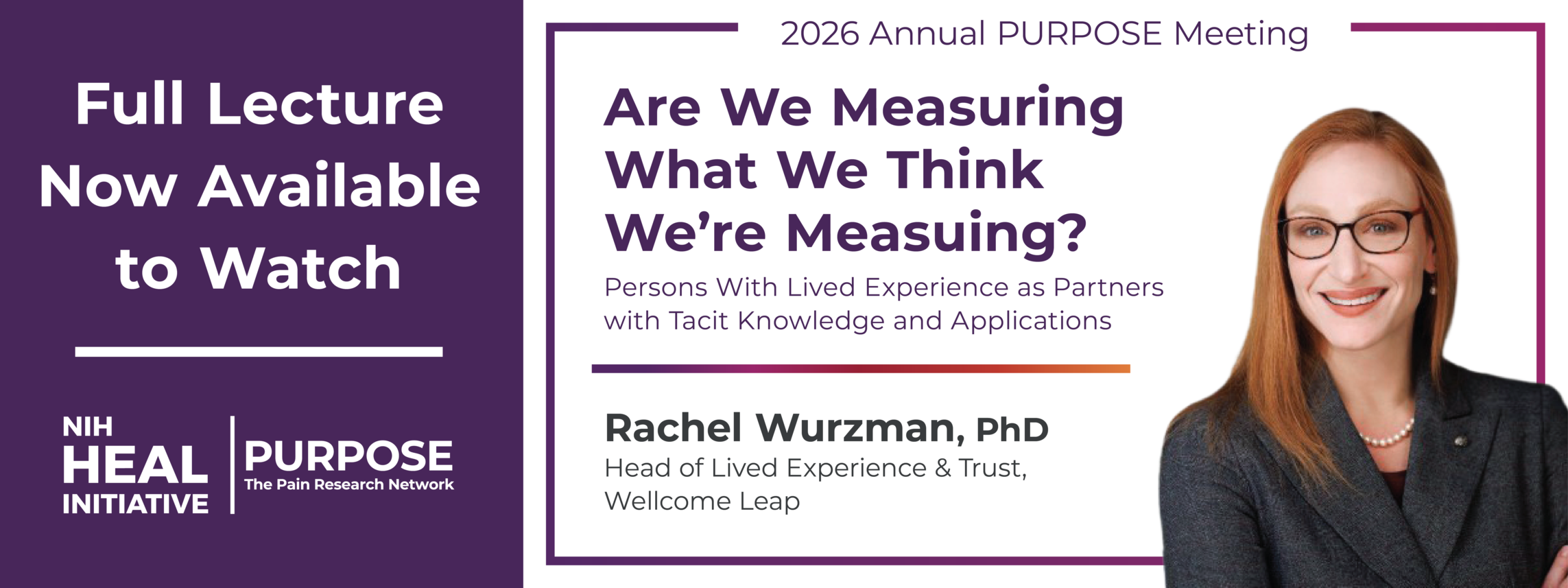
New Video Now Available: Lived Experience as Research Partnership
Now Available: Are We Measuring What We Think We're Measuring? Persons With Lived Experience as Partners with Tacit Knowledge and Applications
Watch the full presentation now in the Media Center
Speaking at the 2026 PURPOSE Annual Meeting, Rachel Wurzman, PhD, Head of Lived Experience and Trust at Wellcome Leap, argues that integrating People with Lived Experience (PWLE) into neuroscience is a core methodological necessity for scientific rigour, rather than merely an ethical or logistical tool for trial recruitment. Drawing on her perspective as both a neuroscientist and an individual living with chronic pain and Tourette's syndrome, Wurzman demonstrates how qualitative insights from PWLE address fundamental epistemological gaps in empirical research. She illustrates how subjective expertise rectifies flawed construct validity, accounts for latent variables driving large proportions of unexplained variance in prognostic models, and prevents mechanistic misinterpretations of quantitative outcomes across neurodevelopmental and neuropsychiatric domains.
Key areas covered in the presentation:
-
Fixing Measurement Gaps: Standardized quantitative metrics frequently collapse complex, multidimensional subjective phenomena into unidimensional proxies. Discover how partnering with PWLE repairs flawed construct validity by ensuring clinical endpoints accurately map onto specific neural state spaces under investigation.
-
Accounting for Unexplained Variance: Advanced prognostic models in neuroscience routinely leave significant variance unexplained. Learn how qualitative insights uncover hidden temporal, environmental, and physiological variables that standard prognostic models miss, allowing researchers to refine regression models and isolate true treatment responders.
-
Refining Disease Ontology: Statistical significance and therapeutic efficacy do not automatically imply equivalent underlying pathology. Wurzman breaks down why effective clinical interventions do not necessarily reveal true disease mechanisms and how lived experience provides critical boundary conditions to properly interpret neurophysiological data.