

Maximizing the Value of Rigorous Research Through NIH-Funded Data and Biospecimen Repositories, with NIH Institute and Center Perspectives
NIH supports an array of data and biospecimen repositories that help ensure valuable scientific resources remain available to qualified researchers for future studies. Many repositories link biospecimens to rich clinical, phenotypic, imaging, genomic, or longitudinal datasets, allowing researchers to validate findings across multiple data types and apply modern analytical approaches. Here, we briefly discuss the policies and principles governing data management and repositories. Then, we spotlight selected examples of NIH-supported repository programs.
When appropriately preserved, curated, and shared, these data and repositories enable and accelerate new discoveries, support validation of research findings, strengthen transparency, and extend the impact of NIH-supported research investments far beyond the original study. As such, these resources play a critical role in advancing scientific rigor, reproducibility, transparency, and responsible stewardship of participant contributions.
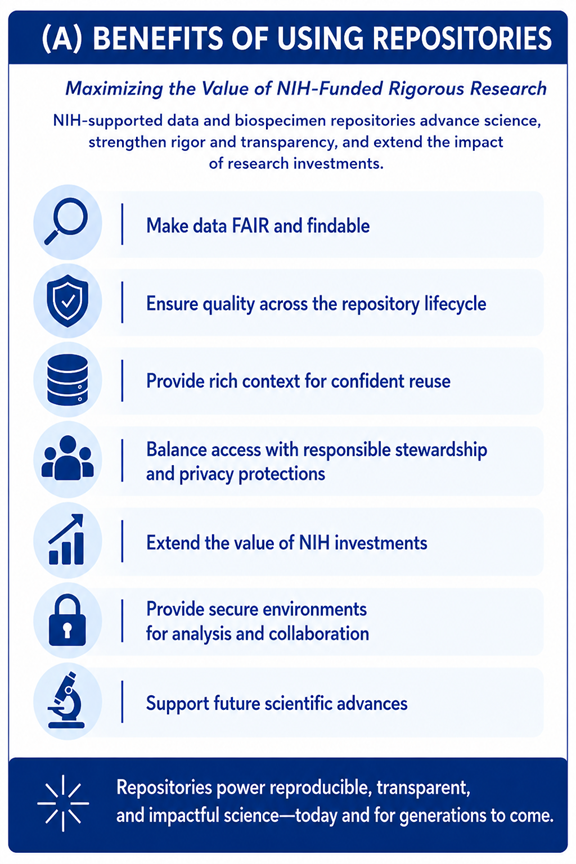
Our support for these resources further:
- Facilitates the FAIRness of the data (Findable, Accessible, Interoperable, and Reusable)
- Embeds quality assurance throughout the resource lifecycle, from collection and processing to curation and long-term preservation
- Pairs specimens and datasets with robust metadata, documentation, and provenance information, allowing investigators who were not involved in the original study to confidently interpret and reuse resources
- Extends the value of NIH-funded research and reduces the need to collect duplicate data or specimens by enabling secondary analyses, validation studies, and new scientific questions
- Provides secure environments for analysis, collaboration, and discovery
- Uses research participant data and specimens appropriately to support future scientific advances, including moving towards more human-centered approaches to study mechanisms of human disease (an NIH priority)
Repositories supported across NIH share common commitments to scientific rigor, responsible stewardship, and maximizing the value of participant contributions. They also can vary in their scientific focus, collections, and access models. Example characteristics may include:
- Mission-specific resources tailored to the scientific disciplines and research communities
- Integrated research platforms with analysis workbenches, artificial intelligence tools, reference materials, and/or curated collections
- Flexible participation models
- Connected research ecosystems linking biospecimens with clinical, imaging, genomic, and other complementary data
- Specific governance that considers scientific access and unique needs of the resource and research community
The selected examples below from NIH Institutes, Centers, and Offices (ICOs) (in no particular order) illustrate how different ICOs operationalize these principles through their repository programs. Potential interested researchers should appreciate that each repository has its own scientific scope, submission policies, and access models to follow. Selecting the ICO name will provide a drop-down with additional information.