

Advancing Pain Research Together: Highlights from PURPOSE at SfN 2026
Thank you to everyone who joined us in person and online on November 13 for our fourth annual PURPOSE preconference meeting at the 2026 Society for Neuroscience. Hosted by PURPOSE, the day brought together basic scientists, clinical researchers, NIH leadership, and persons with lived experience (PWLE) of pain to strengthen funding strategies, data reuse, mentorship, science communication, and patient partnerships.
Here is a look back at the key takeaways and resources shared throughout the program:
Navigating the NIH and HEAL Funding Landscape
-
HEAL Pain Portfolio Update (Michael Oshinsky, PhD, NINDS): Congress has maintained strong funding for the NIH HEAL Initiative pain portfolio. Because traditional Notice of Funding Opportunity (NOFO) searches are increasingly replaced by broader parent announcements, investigators should develop their research ideas first and reach out directly to NIH program officers before applying. Dr. Oshinsky highlighted 13 active HEAL pain programs across eight priority domains, spanning training awards, FDA aligned biomarkers, target validation, early therapeutic screening, translational contracts, medical devices, and small business grants.
-
NIH Funding Pathways and Early Career Transitions (Wilson Compton, MD, MPE, NIDA and Wendy Weber, ND, PhD, NCCIH): Both NIDA and NCCIH reaffirmed their commitment to pain research and early stage investigators, noting increases in K awards and overall NIH targets. Leadership previewed upcoming efforts to streamline K mechanisms into two broader announcements and encouraged investigators to monitor published NIH forecasts, utilize parent R01 announcements, and explore the NIH Loan Repayment Program.
The Evolution of Pain Science
-
From Mechanisms to Translation (Ru-Rong Ji, PhD, Duke University): Tracing his 30 year career from acupuncture analgesia and opioid receptor mapping to intracellular signaling, Dr. Ji illustrated how pain research has expanded beyond neurons to focus on neuroimmune and neuroglial interactions. He highlighted discoveries in spinal microglia and astrocyte activation, sex specific pain pathways, and specialized pro resolving mediators that actively resolve acute pain. Looking toward translation, he shared promising work on functional monoclonal antibodies targeting MMP-9 for diabetic neuropathy, biased GPCR allosteric modulators, and intercellular mitochondrial transfer.
Leveraging Big Data in Pain Research
-
Secondary Data Analysis and Integration (Luana Colloca, MD, PhD, MS, University of Maryland, Baltimore): Drawing on her newly awarded HEAL R01, Dr. Colloca walked through the scientific, ethical, and regulatory steps required for responsible data reuse. Key practices include securing proper IRB determinations and Data Use Agreements, aligning variables with HEAL Common Data Elements (CDEs), preregistering Statistical Analysis Plans to avoid data fishing, and replicating original findings as a quality check.
-
The HEAL Data Ecosystem (Julia Berzhanskaya, PhD, NINDS; Suparna Goswami, PhD, RENCI; Phil Schumm, MA, University of Chicago): The HEAL data stewards demonstrated how the HEAL Data Platform acts as a federated data mesh connecting more than 170 studies and 350 standardized CDEs. Attendees learned how to discover datasets via HEAL Semantic Search and analyze open or controlled access data inside secure, cloud based JupyterLab workspaces.
Mentorship, Lab Culture, and Career Sustainability
-
Building a Supportive Network (Robert W. Gereau, PhD, Washington University in St. Louis): Reflecting on the evolution of his own lab, Dr. Gereau emphasized building lab cultures intentionally around core values. He encouraged trainees to evaluate prospective labs based on alumni career outcomes and urged principal investigators to start every mentoring relationship with the end in mind, tailoring projects to support each trainee's individual career trajectory.
-
Sustaining a Career in Pain Research (Carolyn A. Fairbanks, PhD, University of Minnesota): Dr. Fairbanks shared practical strategies for navigating institutional shifts, unexpected disruptions, and national policy changes through early institutional service, government relations partnerships, and advocacy. Addressing the significant time researchers lose to compliance and administrative tasks, she highlighted the Federal Demonstration Partnership and shared how a university wide Faculty Burden Reduction Committee can eliminate unnecessary administrative overhead.
Science Communication and Lived Experience Partnerships
-
Giving a Better Presentation (Penney Cowan, RT, ACPA and Edwin Aroke, PhD, CRNA, UAB): Using a countdown of 10 common presentation pitfalls, Cowan and Dr. Aroke showed how unexplained jargon, crowded figures, small fonts, and reading from slides can lose a mixed audience. They advised speakers to anchor talks in one clear central message, tailor framing to their audience, present key takeaways before showing data, and treat people living with pain with dignity and validation.
-
Interactive Dialogue with PURPOSE PWLE Advisors (Rachel Wurzman, PhD; Kate M. Nicholson, JD; Aryn Lee; Quána Madison, MA): In a live Socratic dialogue, PWLE advisors shared how lived experience strengthens every phase of research, from identifying gaps in legacy patient reported outcome measures to improving study retention and translating findings for patients and policymakers. Panelists encouraged researchers to involve PWLE advisors early, ask open ended questions, and budget fairly for both individual advisors and the patient organizations that support them.
Keep the Momentum Going on PURPOSE
-
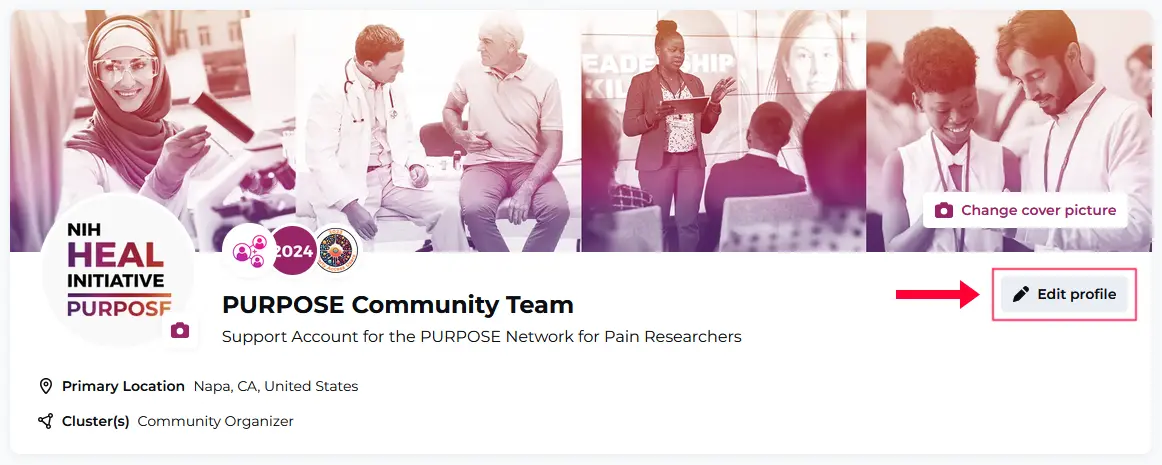
Update Your Profile: Let the community know what lived experience perspectives or research collaborations could help advance your work, and try out our new Follow feature to stay updated on colleagues' posts.
-
Join a Group: Continue the conversation in the Data Analysis, Sharing and Management group, the Lived Experience of Pain group, or the Sickle Cell Related Pain group.
-
Save the Date: Register on PURPOSE for our upcoming webinar on December 8 with Rajesh Khanna, PhD, MSc, on building a matrix mentoring network.