
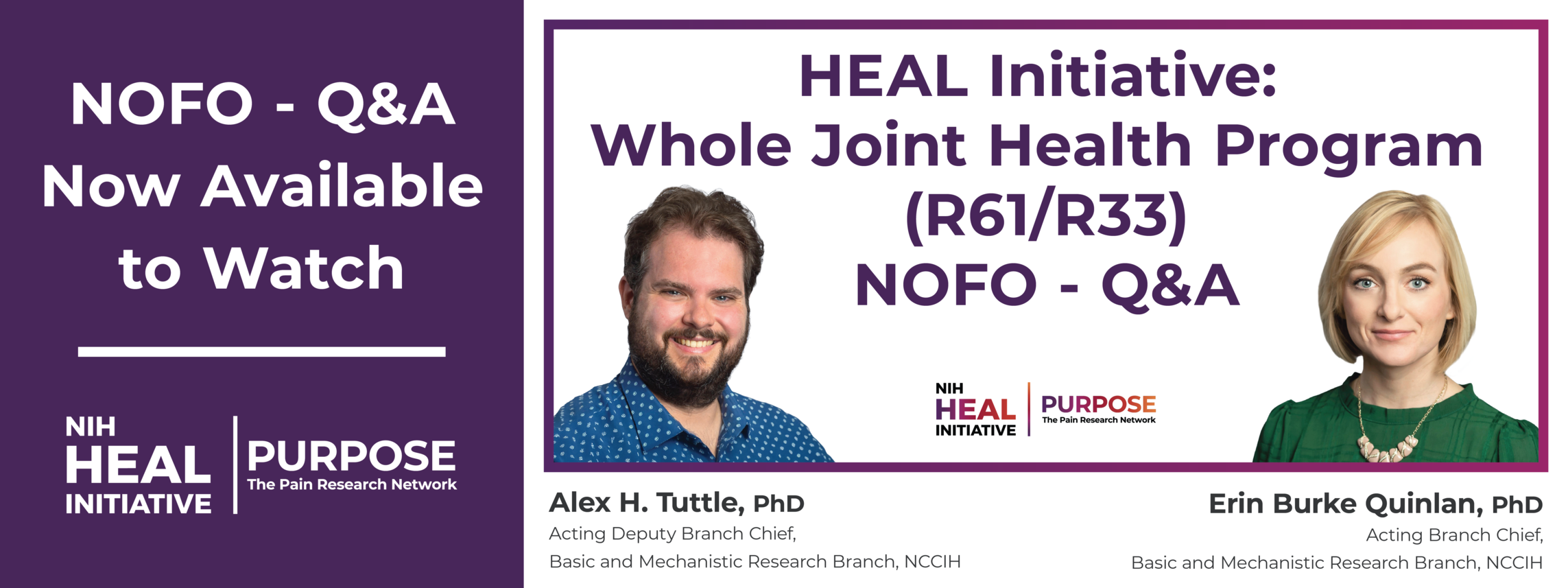
Now Available: HEAL Initiative: Whole Joint Health Program (R61/R33) NOFO - Q& A
New Video Available: HEAL Initiative: Whole Joint Health Program (R61/R33 Clinical Trial Required) - Question & Answer
Watch the Q&A now in the Media Center
Alex H. Tuttle and Erin Burke Quinlan presented on the upcoming NIH HEAL Initiative Whole Joint Health Program (R61/R33) (PAR-27-045), and answered questions.
Presenters:
-
Alex H. Tuttle, PhD | Acting Deputy Branch Chief, Basic and Mechanistic Research in Complementary and Integrative Health Branch, NCCIH
- Erin Burke Quinlan, PhD | Acting Branch Chief, Basic and Mechanistic Research in Complementary and Integrative Health Branch, NCCIH
Funding Opportunity Purpose:
The NIH Helping to End Addiction Long-term®(HEAL) Initiative is releasing this Notice of Funding Opportunity (NOFO) to support a phased mechanistic clinical research program focusing on understudied biological mechanisms that drive joint pain.
The phased projects supported by this program (of up to five years total in duration) will first identify and validate multi-tissue mechanisms underlying joint pain, then test non-pharmacologic or multimodal interventions that directly target these mechanisms. The initiative responds to priorities identified in the 2023 HEAL Whole Joint Pain Workshop and supports the broader goals of the NIH HEAL Initiative and the Make America Healthy Again vision by advancing safe, non-addictive, and prevention-oriented approaches to chronic pain.
For the latest information and complete grant details, visit: https://simpler.grants.gov/opportunity/703509fe-0d61-4f19-9a44-59d02da62ba4
Research Objectives:
This two-phase NOFO will support well-powered, hypothesis-driven mechanistic clinical studies aligned with HEAL's whole joint health priorities.
R61 Phase (2 or 3 Years):
In the R61 phase, studies will test innovative whole joint mechanisms in healthy and clinical pain populations to generate strong preliminary data to support the R33 clinical trial. Studies will include one or more observational or mechanistic clinical study(ies) that measure whole joint mechanisms, including at least one periarticular tissue and the interactions with one or more articular tissue(s) and/or peripheral physiological or neural system(s), to demonstrate measurable differences in joint pain and pathophysiology between a clinical population with joint pain versus a healthy population with no joint pain.
This NOFO prioritizes innovation in the proposed measures of whole joint mechanisms. The inclusion of multiple tissues and mechanisms involved in whole joint function as well as joint pain and pathophysiology is considered a strength.
Specific Areas of Research Interest
Examples of innovative mechanisms include (but are not limited to):
- Multi-tissue pathology (e.g., combined subchondral bone, synovial, adipose tissue, fascia, muscle, immune, and ligamentous pathology);
- Abnormal biomechanics or load distribution (e.g., focal stress points, maladaptive loading, shear forces); and
- Inter-tissue communication (e.g., bidirectional signaling among periarticular, articular, and sensory tissues).
This NOFO will also support studies that may incorporate innovative or cutting-edge imaging, biomarker profiling, neuromuscular assessment, and/or behavioral or environmental measures. Other multimodal approaches that meet NIH standards for rigor and reproducibility will also be supported.
R33 Phase (2 or 3 Years; Total Project Period 5 Years or less):
The R33 phase supports mechanistic clinical trials to test the effects of non-pharmacologic or multimodal interventions on the proposed mechanisms demonstrated in the R61 phase. The selected intervention and its expected mechanistic impact should be well-justified and coupled with a rigorous clinical trial design. The rationale for the proposed intervention may be based on prior work published in the literature or preliminary data generated in the R61 phase using appropriate models, organisms, or human populations.
Examples of appropriate non-pharmocologic interventions for joint pain include (but are not limited to):
- Manual therapies and force-based manipulations;
- Exercise and movement-based therapies;
- Thermotherapies;
- Dry needling or acupuncture;
- Targeted injection therapies;
- Neuromodulation interventions; and
- Multimodal combinations, including peripherally-targeted pharmacologic or non-pharmacologic therapies.
This NOFO will support additional interventions if there is evidence provided supporting its relevance to the joint tissues studied in the R61 phase and if the intervention is likely to produce measurable mechanistic changes. Additional approaches may include devices, drugs, or other multimodal therapies.