

Funding Rate Data for R01-Equivalent and R21 Awards by Career Stage: Encouraging Early Stage Investigators to Pursue Larger Awards
Finding the right funding opportunity as an early career investigator can feel overwhelming but understanding the NIH funding landscape can help inform your choice. Generally speaking, investigators should choose the funding opportunity and grant type that is appropriate to support their science and career stage. However, early career researchers may feel that they are more likely to receive funding by pursuing a smaller or shorter duration award such as an R21 over an R01-equivalent award, when this may not actually be the case.
When the science, scope, and eligibility requirements support doing so, NIH leadership strongly encourages early career researchers to focus on seeking R01-equivalent grants (see also this historical Nexus article). This approach is consistent with NIH’s long-standing commitment to promoting the sustainability of the biomedical research workforce.
- NIH Institutes, Centers, and Offices (ICOs) prioritize early stage investigators (ESIs) in their funding decisions, setting annual funding targets of R01-equivalent awards to ESIs based on the number of ESI applications received. Learn more on their ICO profile pages and this NIH Extramural nexus article.
- Our Unified Funding Strategy calls upon ICOs to consider investigator career stage when making funding decisions (watch this webinar for more).
Below, applicant funding rate data are provided for R01-equivalent and R21 awards broken down by career stage. Before going into the data, readers should understand the following:
- The applicant funding rate is a person-based metric representing the number of unique awardees divided by the number of unique applicants submitting new (Type 1) applications per fiscal year (FY).
- We refer to investigators receiving awards for simplicity but recognize that NIH makes awards to institutions (not individual researchers).
- ESIs are those researchers who are within 10 years of their terminal research degree or end of post-graduate clinical training and who have not received a substantial NIH independent research award. More information is available about ESI applications here.
- New investigators (non-ESIs) are researchers new to the NIH system but more than 10 years beyond their terminal degree or completion of clinical training.
- At-risk investigators are those who have received a prior substantial NIH award but will have no funding the following fiscal year if they are not successful in securing a competing award this year.
- Established investigators have received a prior substantial NIH award and will have NIH funding the following fiscal year irrespective of the outcome of this year’s competitions.
- These data include analyses of awards made with direct budget authority and exclude awards made with COVID-19 supplemental appropriations.
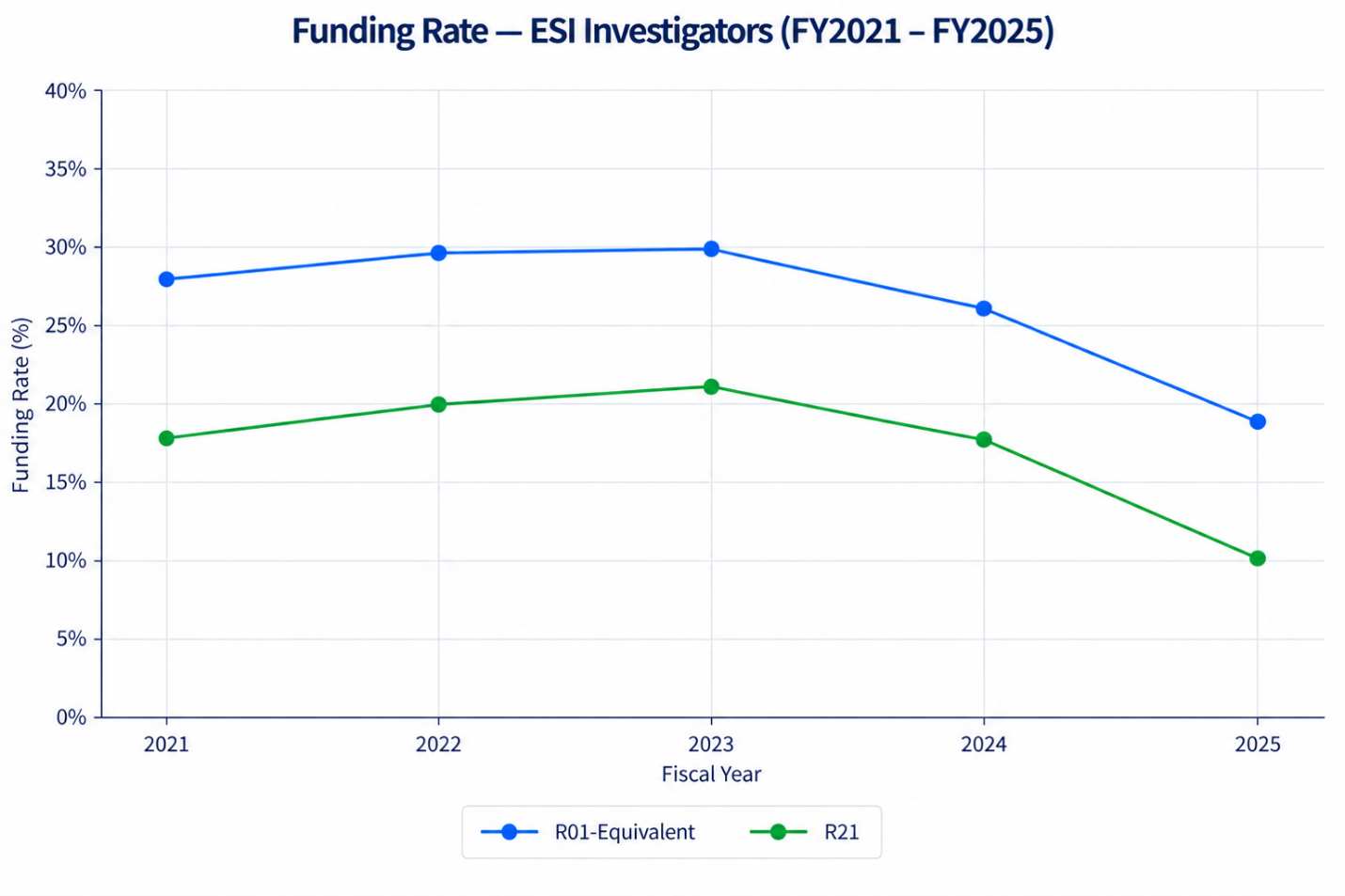
Figure 1.
So, what do the data tell us?
- From FY21 through FY24, more than one-quarter of ESI applicants for R01-equivalent awards received funding (Table 1 and Figure 1), with funding rates ranging from 26% to 30%. In FY25, the ESI funding rate declined to 18.9%, due in part to NIH forward funding more competing research project grants (see this NIH Extramural Nexus article for more insights). Although the same overall trends are seen, funding rates for R21s for ESIs are substantially lower than for R01-equivalents, by approximately 10 percentage points each year (Figure 1).
- ESIs had the second-highest R01-equivalent funding rate among the four career-stage groups across all five years, second only to established investigators (Table 1). In every year examined, established and at-risk investigators had higher funding rates for R21s than ESIs (Table 2 and Figure 2).
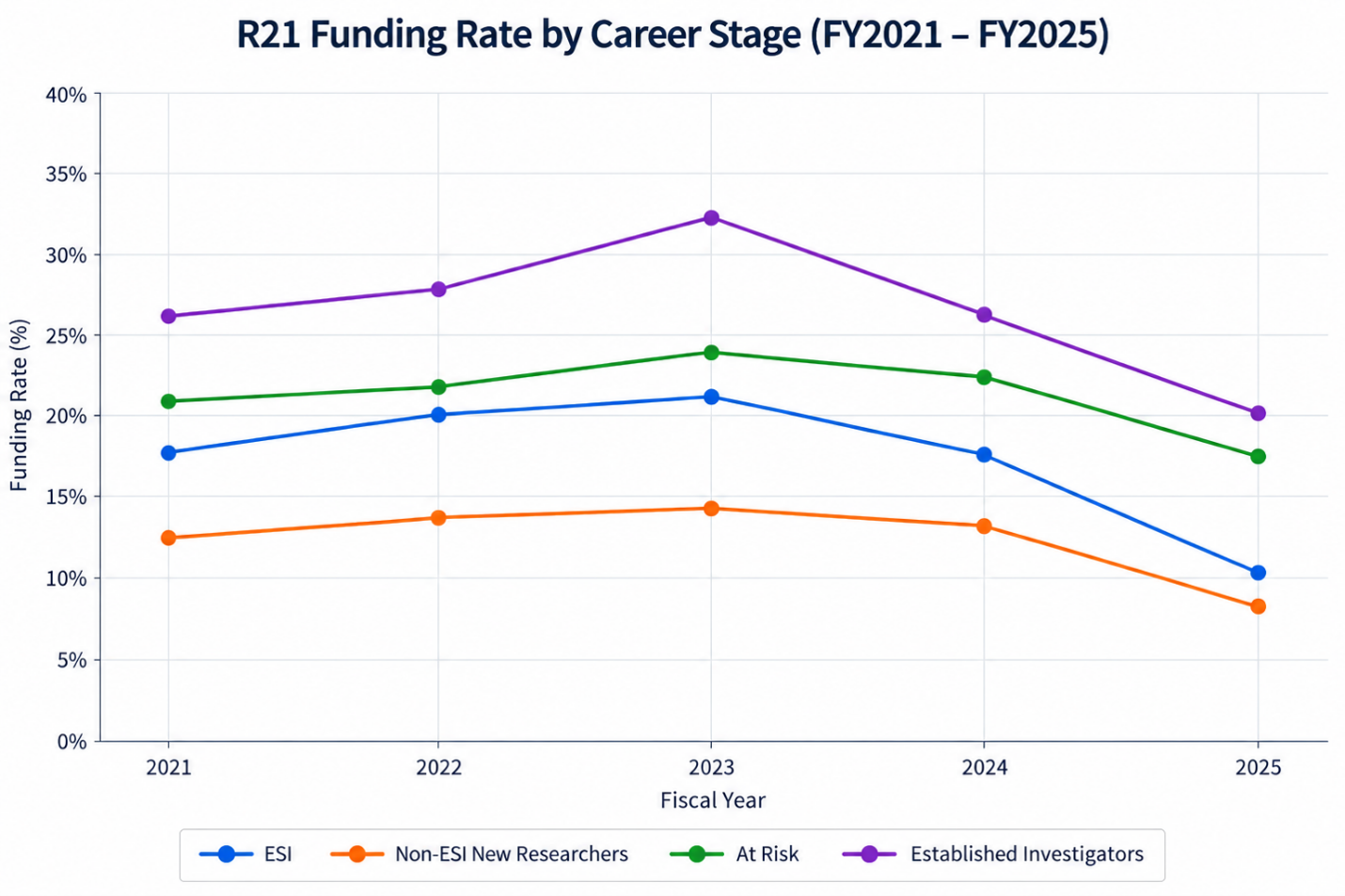
Figure 2.
The data reinforce an important point for ESIs: a smaller or shorter award does not necessarily mean an easier award. Among those who applied, ESIs had relatively strong funding rates for R01-equivalent awards, while funding rates for R21s were consistently lower than for R01-equivalents. So, when the science, scope, and eligibility requirements support an R01-equivalent application, ESIs should probably pursue one rather than applying for an R21.