

From Scientific Learners to Leaders: Three New Parent Research Education Funding Opportunities, with Perspectives from NIH Institutes, Centers, and Offices
As part of NIH's broader effort to simplify the funding landscape, we’re pleased to highlight three new parent funding opportunities under the NIH Research Education Program (R25). Similar to updates to career development, loan repayment, and predoctoral/postdoctoral transition programs, these new research education programs provide a simpler framework for supporting research education activities while helping NIH develop the scientific workforce of the future (a continued and long-standing NIH priority). Please also plan to join us on November 5, 2026, at 2:00 p.m. ET for a webinar discussing these new funding opportunities further (more information coming soon).
What Makes These New Programs Unique
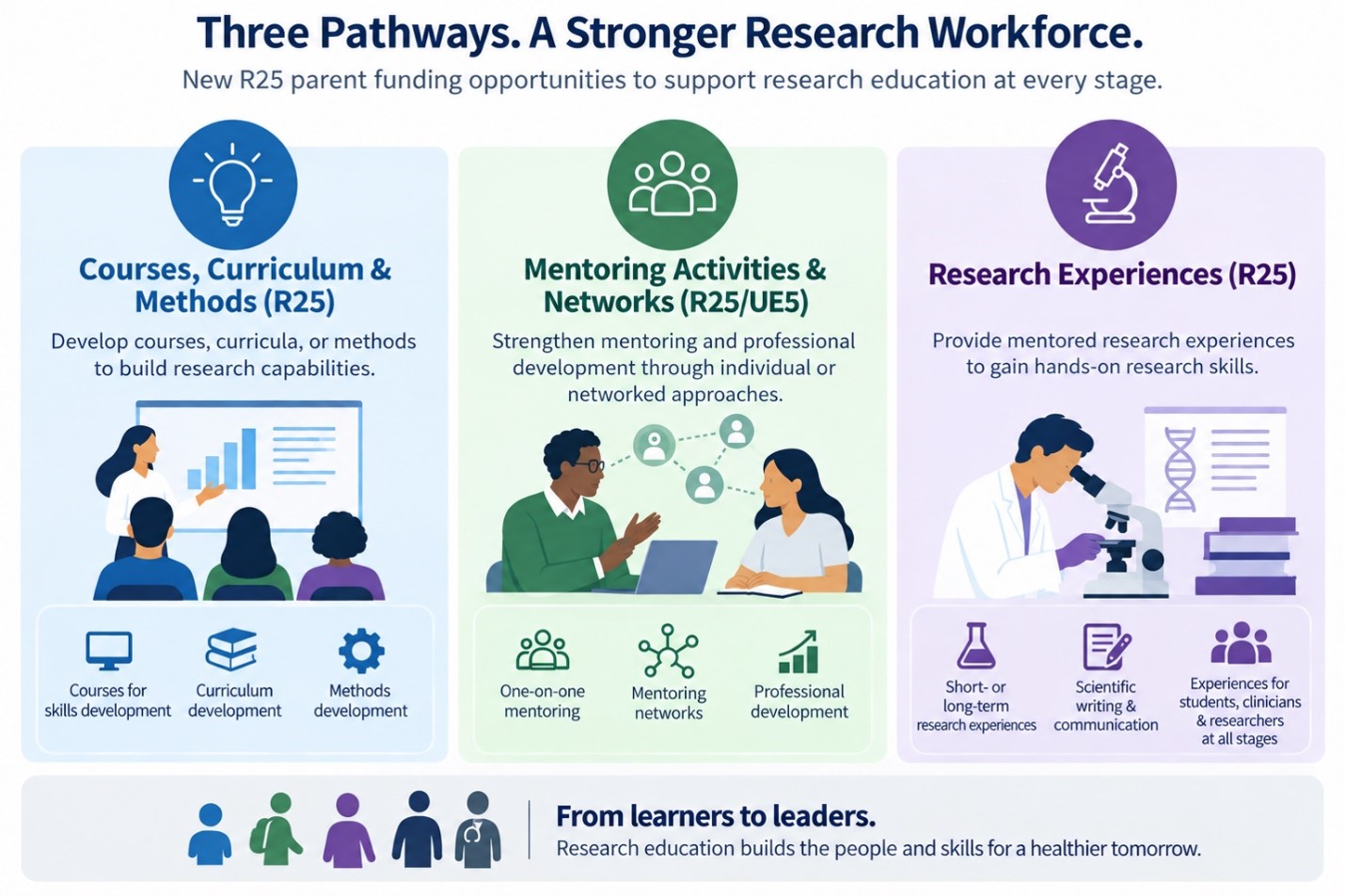
NIH’s research education programs are broader than, but still complement, traditional research training. Through these Notices of Funding Opportunity (NOFOs), NIH supports organizations in developing and implementing research education programs that help develop skills and methods, strengthen mentoring and professional networks, and enhance research experiences. They are also designed to reach participants across educational and career stages, from high school students to established investigators.
And instead of having several different, yet similar, funding opportunities spread across various NIH Institutes, Centers, or Offices (ICOs), these new parent opportunities are easier to use with the same application and review guidance.
The table below can help you identify which opportunity is the best fit.
| Funding opportunity | What it supports | Examples of Supported Activities |
|---|---|---|
| Courses, Curriculum & Methods (PA-27-034) — R25 | Programs that develop research skills, curricula, or methods | Courses that build practical research skills; new curricula, methods, or instructional approaches; programs combining didactic and hands-on experiences; and cross-disciplinary or cross-institutional partnerships. |
| Mentoring Activities & Networks (PA-27-035) — R25/UE5 | Programs that provide mentoring, professional development, and career guidance tailored to participants’ needs and career stages. | National or regional mentoring networks; mentoring that provides scientific expertise, professional guidance, resources, and career development. Single-organization programs are allowed. Awards support an R25 grant or UE5 cooperative agreement. |
| Research Experiences (PA-27-036) — R25 | Programs that provide mentored, hands-on research experiences for participants’ developmental and career-stage needs. | Short-term through longer-term research experiences, often paired with complementary activities such as scientific writing, presentation skills, and other research or career-development activities. |
In order to identify the opportunity that best matches your program, applicants are encouraged to keep a few important considerations in mind before applying:
- Start with the program’s primary purpose. Complementary activities are allowed—for example, a research experience may incorporate mentoring—but select the funding opportunity that best reflects the main focus of your proposed program.
- Consider ICO fit early. Your program should align with the scientific mission and programmatic priorities of a participating ICO. Applicants should also carefully review the organizations listed in the specific NOFO, as participation may vary by opportunity. Prospective applicants are strongly encouraged to reach out to relevant ICO program staff early in the process.
- Read the NOFO and application instructions carefully. Requirements vary by opportunity and may include specific Research Education Program Plan components, page limits, participant requirements, budgets, and other application instructions.
- Keep research education distinct from federally supported training. Proposed activities must be distinct from training programs already receiving federal support, such as NRSA T32 awards, and cannot be used to replace or circumvent NRSA mechanisms.
- Remember that a strong peer review outcome does not by itself ensure funding. ICOs consider scientific and technical merit alongside programmatic priorities, availability of funds, and other considerations when making funding decisions. Learn more about NIH’s Unified Funding Strategy from this recent conversation.
Below are additional insights and advice from some participating ICOs for prospective applicants, ranging from broad scientific priorities to more specific program requirements. Applicants are encouraged to consult the linked ICO profile pages for additional information. Click on the ICO name to expand their information.