

FY25 Inclusion Data for NIH-Supported Clinical Research Now Available by NIH Spending Category
In May, we shared NIH-wide fiscal year (FY) 2025 enrollment data on the sex, race, ethnicity, and age of participants in NIH-supported clinical research, offering a broad view of inclusion across the NIH portfolio. More detailed FY25 enrollment data are now available through the NIH Research, Condition, and Disease Categorization (RCDC) Inclusion Statistics Report.
The interactive report allows users to explore participant enrollment within individual RCDC categories, such as Asthma, Cancer, and Obesity, and by NIH Institutes and Centers (ICs). Reporting these data continue our long-standing commitment to transparency into NIH funding decisions, providing further insights into who is participating in NIH-supported clinical research.
A reminder about NIH inclusion requirements
NIH is committed to scientifically appropriate inclusion of research participants that ensures NIH supports science that will inform clinical practice to benefit all who are affected by the disease or condition under study.
- The NIH Policy and Guidelines on the Inclusion of Women and Members of Racial and/or Ethnic Minority Groups in Clinical Research requires the scientifically appropriate inclusion of women and members of racial and/or ethnic minority groups in clinical research (NOT-OD-25-131). It also requires valid analyses by sex and race and/or ethnicity for NIH-defined phase 3 clinical trials.
- When an NIH-defined phase 3 clinical trial is also an applicable clinical trial (ACT), recipients must report the results of those valid analyses on ClinicalTrials.gov.
- The Inclusion Across the Lifespan Policy requires age-appropriate inclusion recipients whose projects fall under the policy must submit individual-level data on sex, race, ethnicity, and age at enrollment as part of their progress reports (NOT-OD-18-116).
Exploring the RCDC Inclusion Statistics Report
The interactive RCDC Inclusion Statistics Report focuses on sex, race, and ethnicity. FY25 age-at-enrollment data by RCDC category remain available in a separate downloadable Excel file on NIH RePORT’s Inclusion of Women and Minorities in Clinical Research page.
The landing page shows the median percentage of participants in a typical project for the selected demographic variable.
- Drop-down menus allow users to select an IC, fiscal year, and demographic variable.
- Options exist to exclude studies limited to one sex, race, or ethnicity, as well as to export data as an Excel or CSV file.
Figure 1 shows the report landing page, displaying the FY25 Sex summary for all NIH ICs.
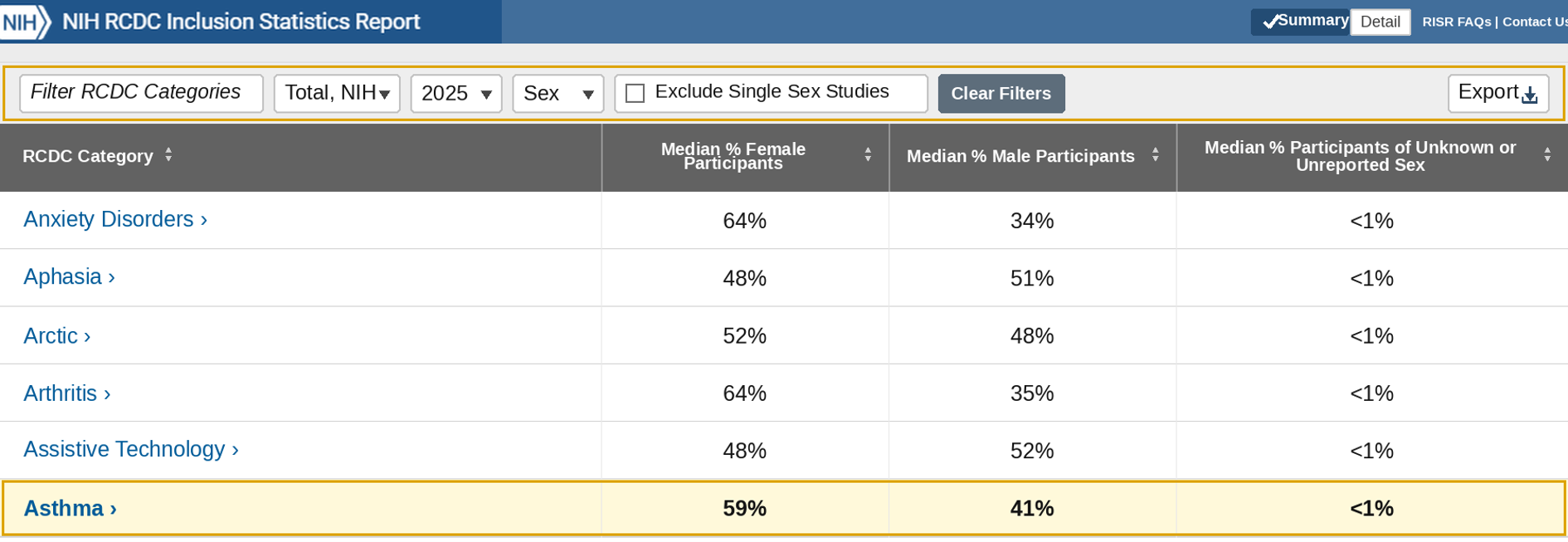
Figure 1. Summary View
Selecting a category opens the detail view. Figure 2 shows the FY25 Asthma category in the Sex view. In the Total, NIH row:
- 54% of participants were female and 45% were male; sex was unknown or not reported for less than 1%.
- Median project-level percentages were 59% female and 41% male, with less than 1% unknown or not reported.
The rows above allow comparisons across ICs.
Use the demographic drop-down menu to select Race or Ethnicity to explore those data. In the Total, NIH row for Asthma:
- The overall race distribution included 1% American Indian or Alaska Native, 3% Asian, 27% Black or African American, 8% reporting more than one race, less than 1% Native Hawaiian or Other Pacific Islander, 49% White, and 11% unknown or not reported.
- In the Ethnicity view, 25% of participants were Hispanic or Latino.
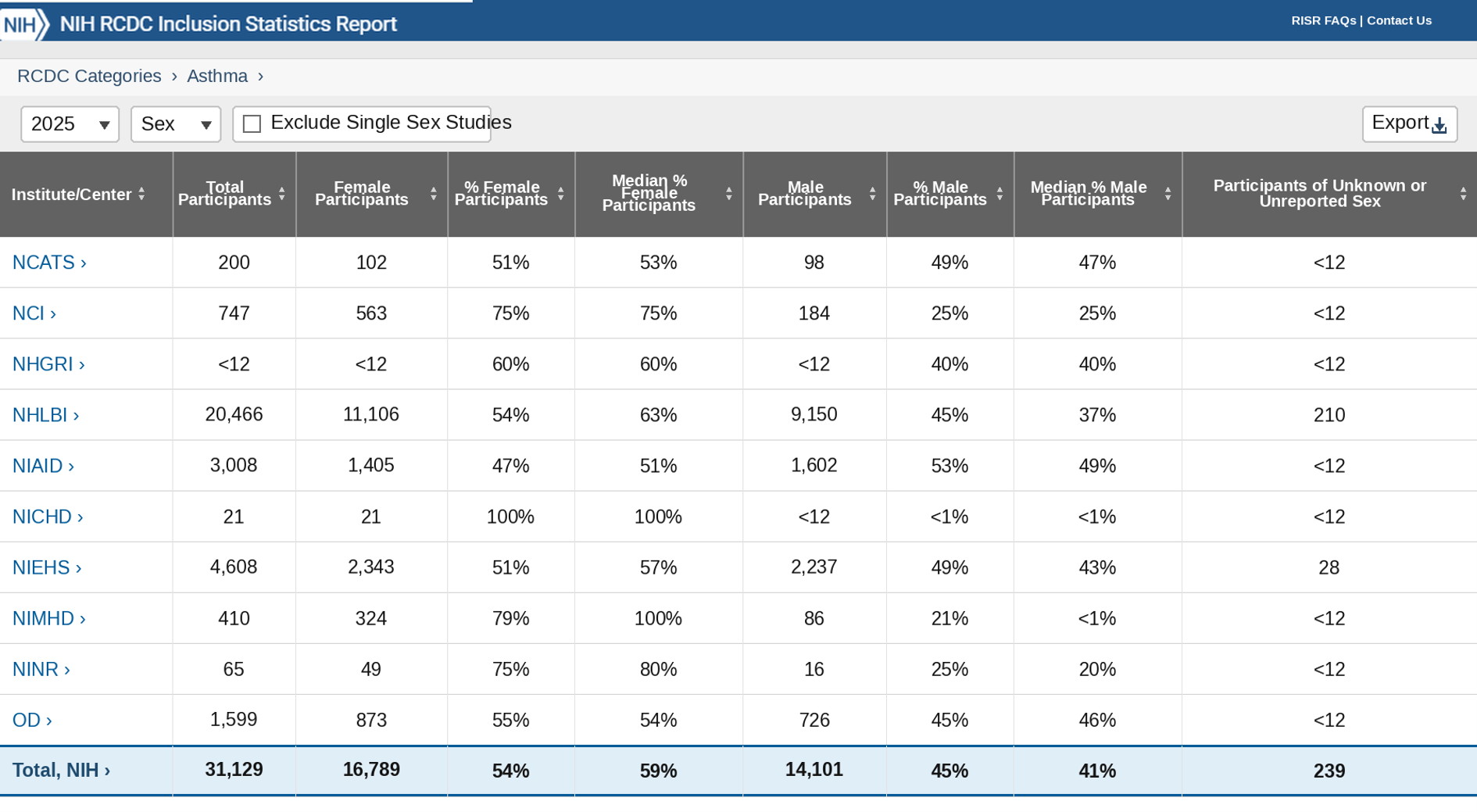
Figure 2. Asthma Category Detail View
Download data on participant age at enrollment
FY25 age-at-enrollment data by RCDC category are available in a separate downloadable Excel file. Figure 3 shows that, in the Asthma category, 68% of participants were children, 27% were adults, 4% were older adults, and age was unknown or not reported for 1% of participants.
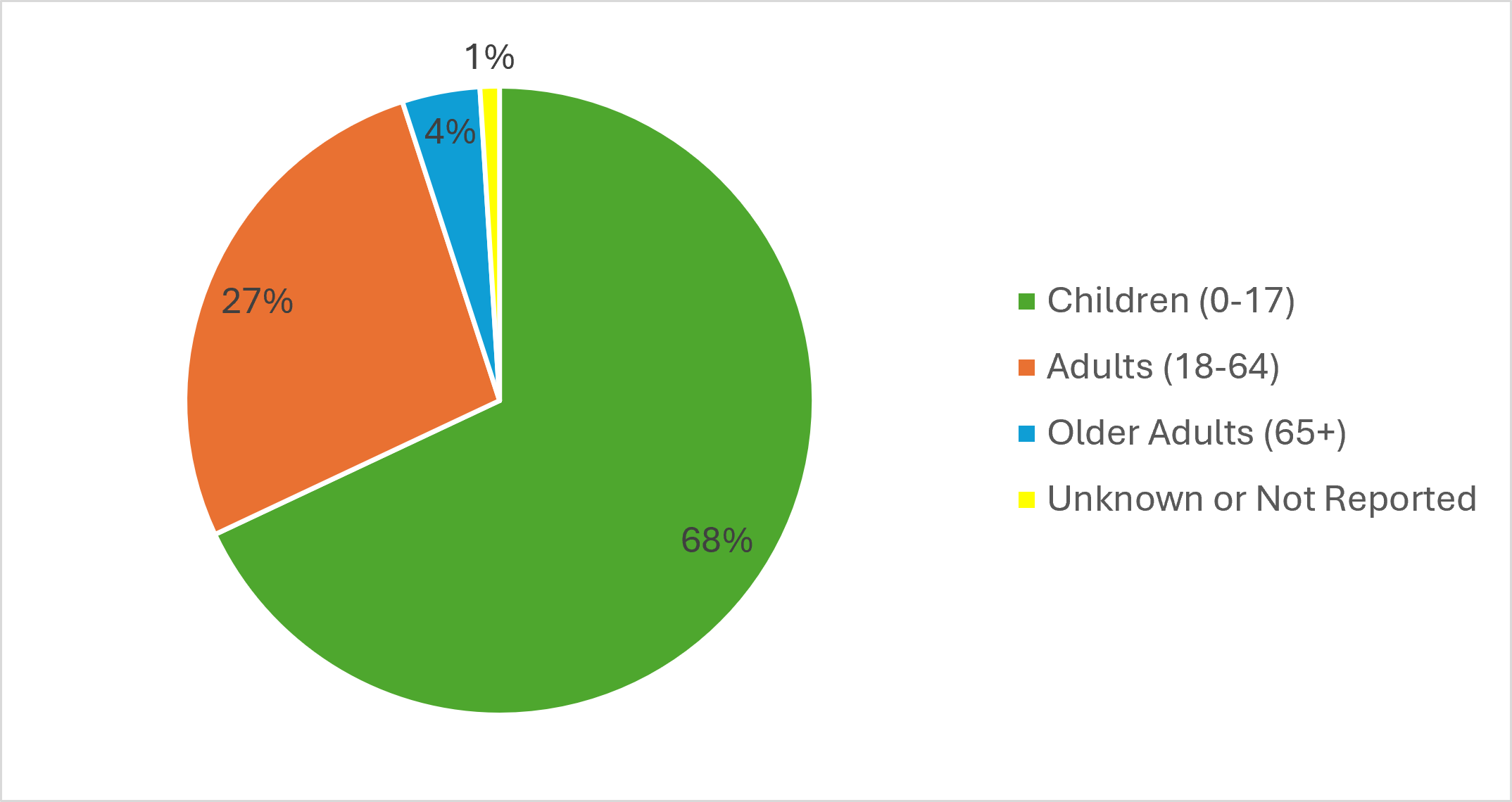
Figure 3. Enrollment in FY25 NIH-Funded Asthma Research by Age Group
Additional Resources:
- RCDC Inclusion Statistics Report FAQs
- NIH Extramural Nexus: New FY 2025 NIH Categorical Spending Data Available