
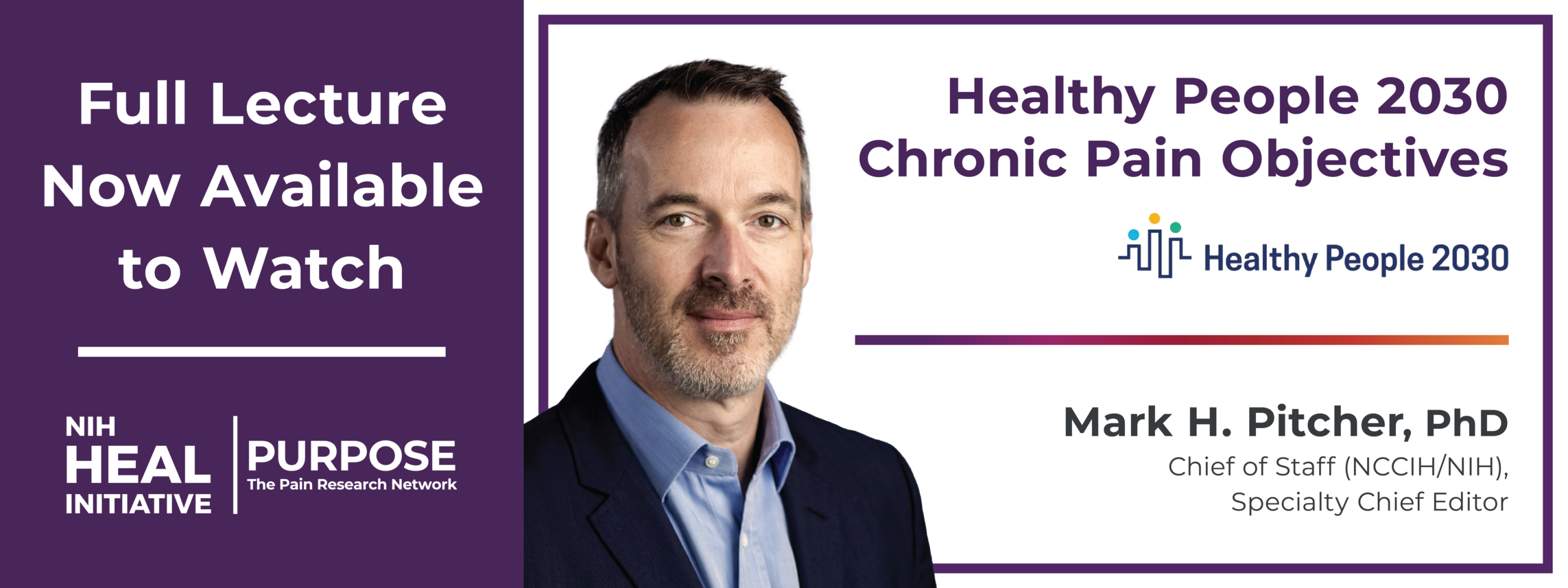
New Video Now Available: Healthy People 2030 and Chronic Pain Objectives
Now Available: Healthy People 2030 Chronic Pain Objectives
Watch the full presentation now in the Media Center
In Episode 18 of the PURPOSE Professional Series, Mark Pitcher, PhD, Chief of Staff at NCCIH, examines the public health trajectory of chronic pain objectives within the Healthy People 2030 framework. Pitcher reviews how standardized metrics for high-impact chronic pain (HICP) were established and analyzes why national prevalence continues to rise despite expanding research and self-management efforts. By mapping the epidemiological transitions between acute and chronic states, he illustrates how social determinants, lifestyle factors, and environmental contexts drive population risk. The session provides researchers and clinicians with a framework for shifting focus from symptom management toward early primary prevention and true pain resolution.
Key areas covered in the presentation:
-
Epidemiological Dynamics of Prevalence: Annual transitions between acute, low-impact, and high-impact states drive rising HICP rates. Discover how tracking population flux rather than static prevalence numbers reveals the underlying drivers of national disease progression.
-
Socio-Environmental Modulation of Biology: Low socioeconomic status, physical occupational demands, and rural health disparities intersect with allostatic load. Learn how these environmental and social drivers directly influence central sensitization, alter cortical thickness, and accelerate neuro-immune pathobiology.
- Ontological Shift Toward Pain Resolution: Population-level prevalence cannot be reduced through symptomatic management alone. Pitcher breaks down why current therapeutic paradigms fail to bend the prevalence curve and how a strategic shift toward disease-modifying primary prevention can achieve true structural pain resolution.