
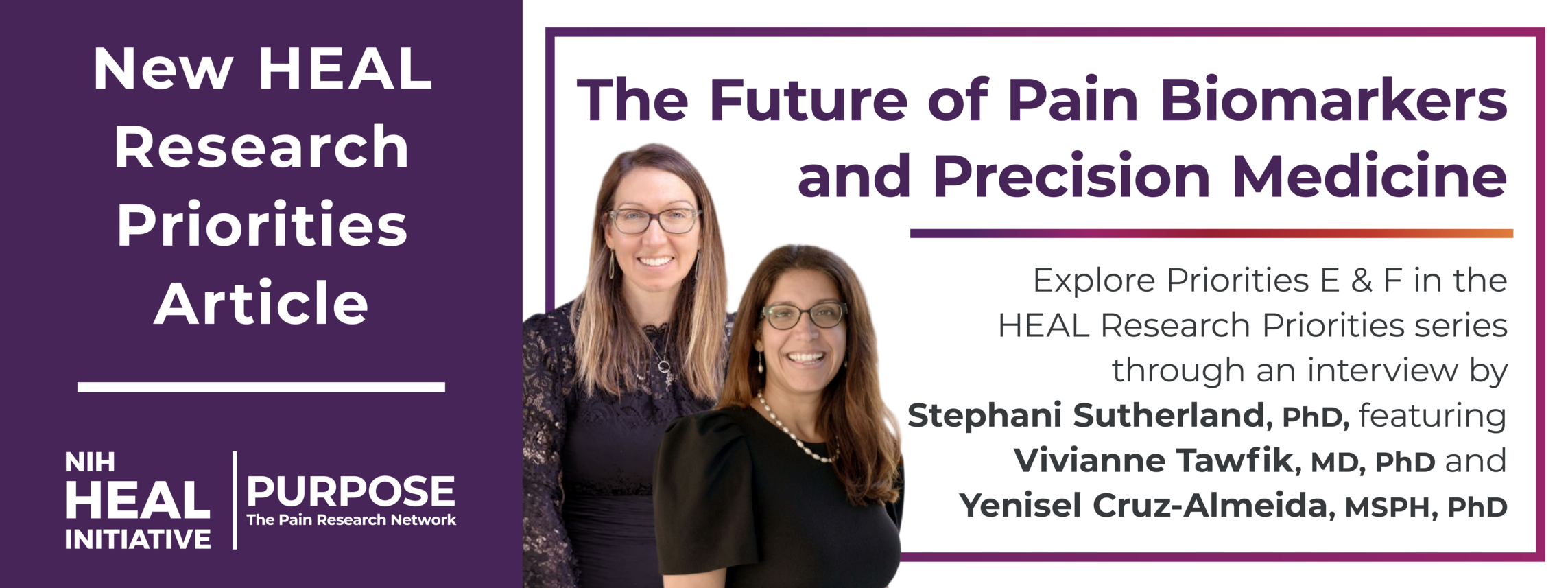
New HEAL Research Priorities Article | Beyond the 1-to-10 Scale: Developing Biomarkers and Composite Signatures for Precision Pain Care
Moving beyond the reliance on subjective self-reporting, the transition toward precision pain medicine requires a validated framework of objective indicators to guide drug development and clinical practice. The latest installment in the HEAL Research Priorities series examines Priorities E and F, which focus on the shift from "one-size-fits-all" treatments to mechanism-based, individualized care.
In this new interview, Stephani Sutherland, PhD, speaks with Vivianne Tawfik, MD, PhD, and Yenisel Cruz-Almeida, MSPH, PhD, about the development of biological correlates and composite "signatures" that capture the multidimensional nature of chronic pain.
Key Topics Include:
-
Surrogate Endpoints and Regulatory Qualification: Evaluating the necessity of objective biomarkers (genomic, proteomic, or physiological) that serve as surrogate endpoints in clinical trials to predict treatment response, safety, and target engagement—a critical step for FDA drug qualification.
-
Deep Phenotyping and Composite Signatures: Transitioning from single-variable metrics to holistic "signatures" that integrate biological markers with patient-reported outcomes (PROs) and psychological data to accurately reflect the biopsychosocial complexity of the pain experience.
-
Precision Implementation and Team Science: Assessing how "black-box" algorithms and AI-driven data mining of electronic health records can match a patient’s unique phenotype with known underlying mechanisms, requiring a cross-disciplinary, team-science approach to pain management.
Read the full interview to explore the frontier of objective pain measurement, and join the discussion in the PURPOSE forum to share your perspectives on the integration of data science and clinical phenotyping.