
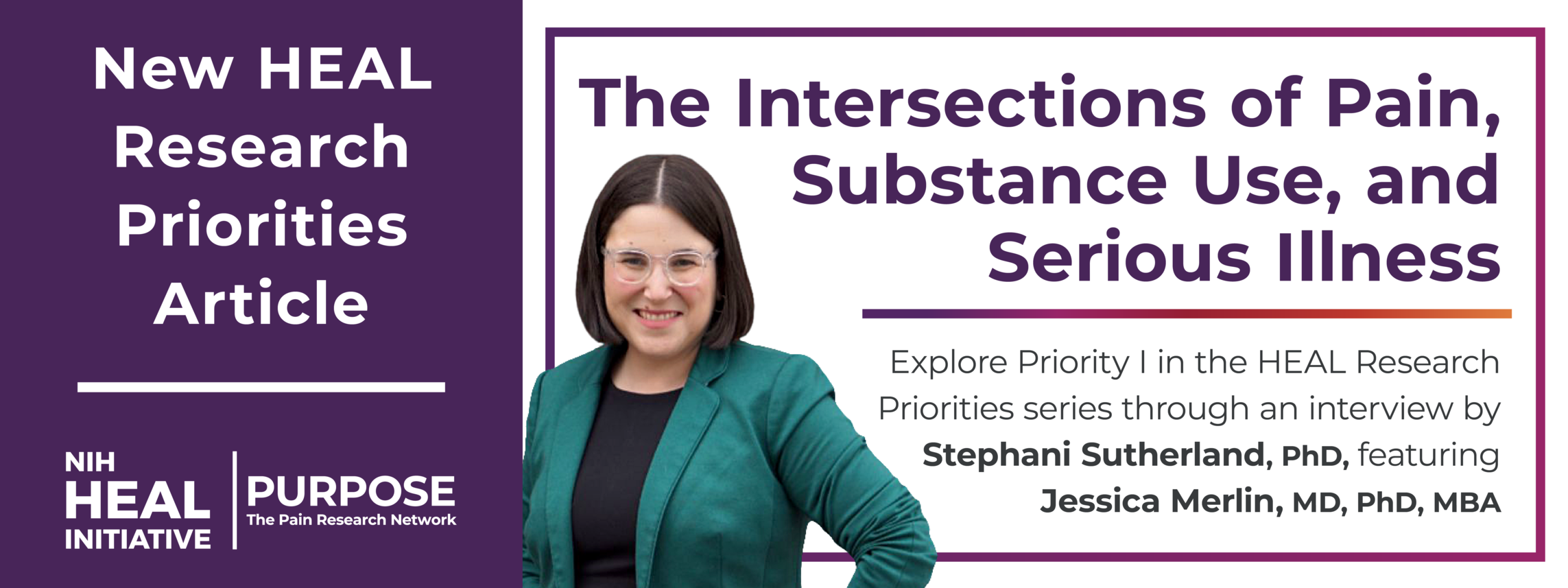
New HEAL Research Priorities Article: The Reciprocal Loop of Pain and Substance Use
The methodological shift toward integrated care requires a sophisticated understanding of the biological and behavioral overlap between chronic pain and substance use. The latest installment in the HEAL Research Priorities series examines Priority I, focusing on the "reciprocal model" where pain and substance use interrelate in a positive feedback loop that complicates clinical outcomes for both.
In this new interview, Stephani Sutherland, PhD, speaks with physician-investigator Jessica Merlin, MD, PhD, MBA, about the necessity of multilevel interventions that move beyond siloed care for co-occurring conditions.
Key Topics Include:
-
Mechanistic Reciprocity: Evaluating the positive feedback loop between pain and substance use, where withdrawal-induced pain and opioid-induced hyperalgesia create significant barriers to long-term recovery.
-
Targeting High-Impact Populations: Identifying the unique clinical challenges faced by patients with cancer, sickle cell disease, or HIV. These populations often require specialized medication management and nuanced de-implementation strategies.
-
Pharmacologic and Systemic Integration: Assessing the role of buprenorphine as a safer partial-agonist alternative for chronic pain and the critical need for universal, bidirectional screening to improve patient retention.
Read the full interview to explore the future of integrated pain and addiction research, and join the discussion in the PURPOSE forum to share your perspectives on navigating these clinical complexities.